Anthropic's $2 Trillion IPO: What It Would Weigh in Your Index Funds
Anthropic is heading for a listing in the days around the November midterms at a valuation reported near $2 trillion. That's roughly double the $965 billion its last private round set in May, and the largest offering ever attempted if it prices there. SpaceX (SPCX) already ran this play in June, so the index rules are no longer hypothetical.
Most savers end up with a simple question: how much of it will I own without choosing to? The answer turns on a number almost nobody quotes, and it produces one odd result.
The fund that is barred from holding Anthropic for at least a year already carries more of it than any fund that can.
SpaceX went through the same rules four months ago
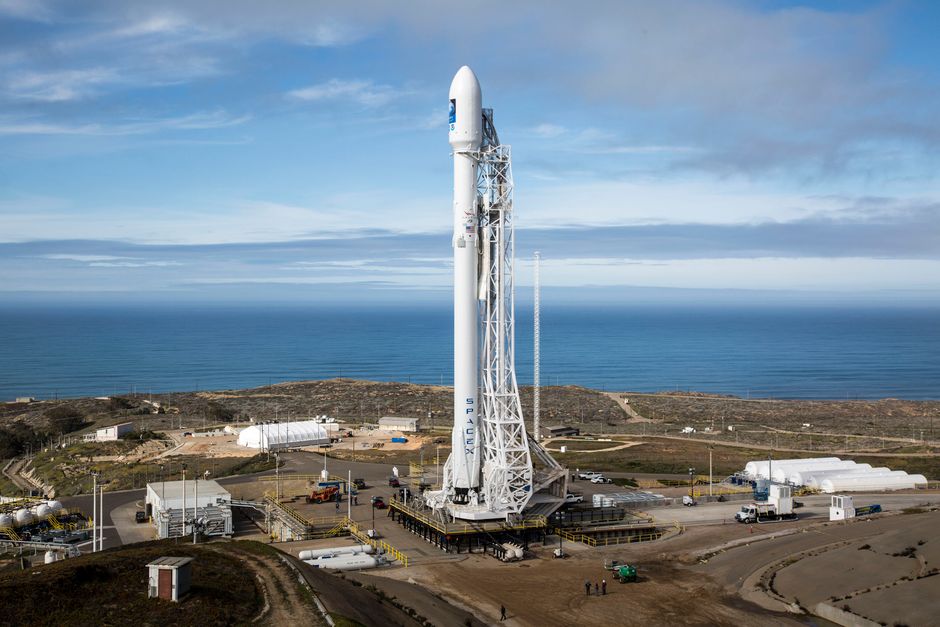
SpaceX priced at $135 a share on June 11 and began trading the next day at about $1.77 trillion. The index machinery then moved quickly. The CRSP total-market index took it in five trading days, and the Russell indexes at about the same pace. The Nasdaq-100 added it on July 7 at a weight near 1%, on a day the stock fell close to 6%. The S&P 500 did not take it, and will not consider it before June 2027.
Four months on, SpaceX closed October 8 around $161, roughly 19% above its offer price and well below its June high. At a market value near $2.18 trillion, it's the sixth-largest company in the United States.
Every rule that decided where it landed applies to Anthropic too, with one difference: more of Anthropic is likely to trade.
Index funds weight the float, and the float is about 5%
A cap-weighted index fund doesn't weight a company by what it's worth. It weights the shares that actually change hands. Anthropic is reported to be seeking up to $100 billion in proceeds, which at a $2 trillion valuation is about 5% of the company. On day one, the figure an index fund works from is that $100 billion.
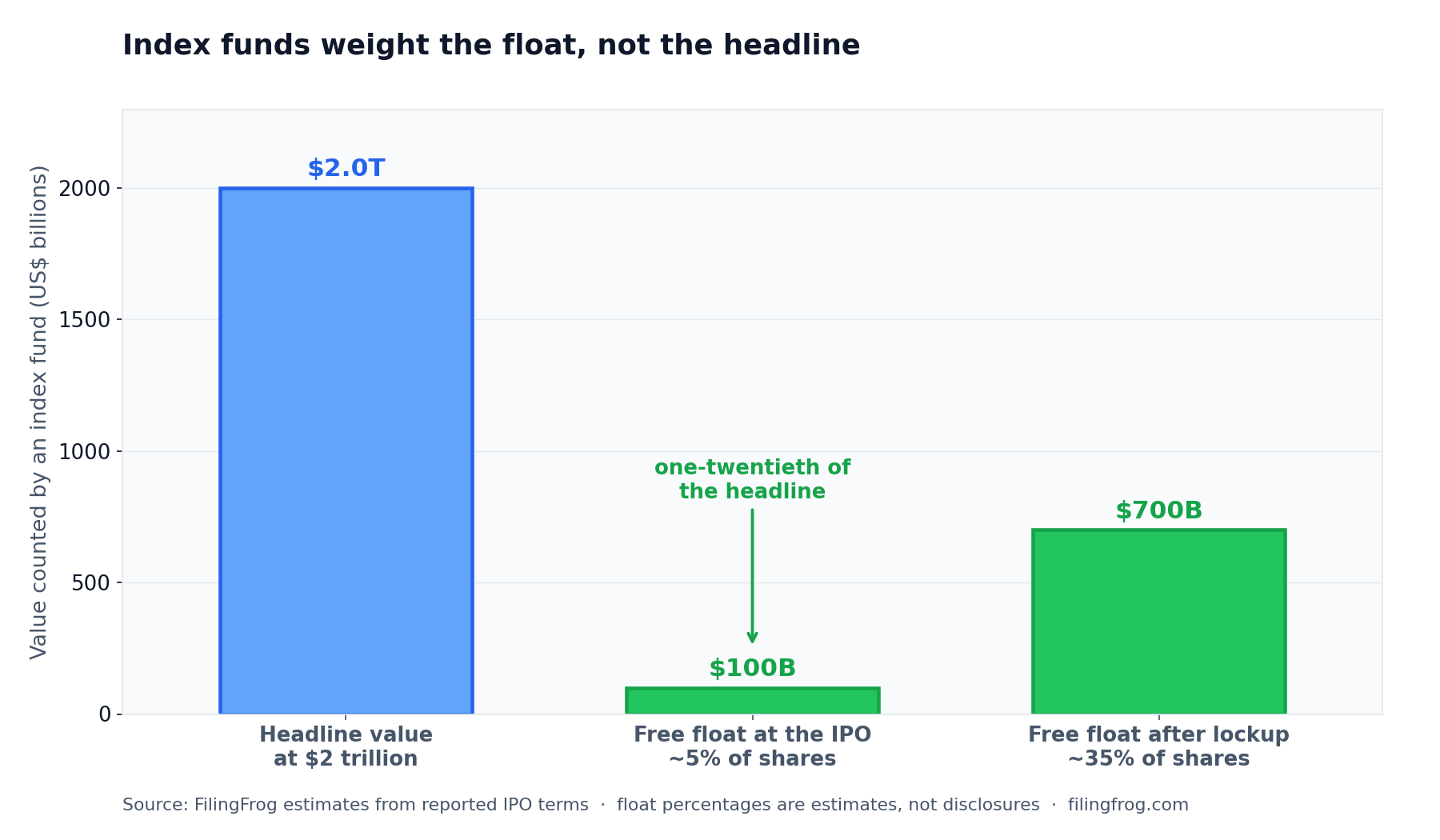
That float widens as the lockups release, and the clock is shorter than it sounds. A standard IPO lockup runs about 180 days, so a November listing puts the bulk of the unlocking inside the first half of 2027, with staged tranches along the way.
Anthropic's cap table is also more open than SpaceX's was. Amazon (AMZN) holds somewhere between 15% and 20%, much of it in non-voting preferred stock and convertible notes rather than common shares, and Alphabet (GOOGL) holds about 14%, contractually capped at 15%. The founders take a separate class. But the rest is spread across dozens of financial investors from nine funding rounds and $118 billion raised, with no single dominant block. So a float near 35% once the lockups have run is a reasonable expectation. No one person holds 42% of Anthropic the way Elon Musk does of SpaceX.
The rulebooks moved before the company did
Since 2017, FTSE Russell has required that more than 5% of a company's voting rights sit in public hands. Anthropic's governance would have struggled with that test. Seven co-founders are set to receive a class of shares carrying 50.1% of the vote. The Long-Term Benefit Trust, whose members hold no financial stake in the company and include former Federal Reserve chair Ben Bernanke, elects four of the seven directors. Public shareholders elect none of them. FTSE Russell amended the rule this year so that large new listings can enter its indexes without clearing the 5% threshold.
Nasdaq scrapped its own 10% float minimum effective May 1 and created a 15-trading-day entry path for new listings large enough to rank among the index's 40 biggest members. S&P Dow Jones went the other way. It consulted in April on bending its rules for the trillion-dollar IPO wave and declined in June, leaving the 12-month seasoning period, the 10% float minimum and the positive-GAAP-earnings test in place.
What it would weigh
Put the float and the index sizes together and the day-one numbers are modest. In a total-market fund like Vanguard's VTI or VTSAX, Anthropic would start around 0.14%, or about $14 of Anthropic for every $10,000 invested. A Russell 1000 fund starts at about the same weight. The technology sector funds pick up about 0.43%, and the Nasdaq-100 starts near 0.75%.
The S&P 500 holds none of it.
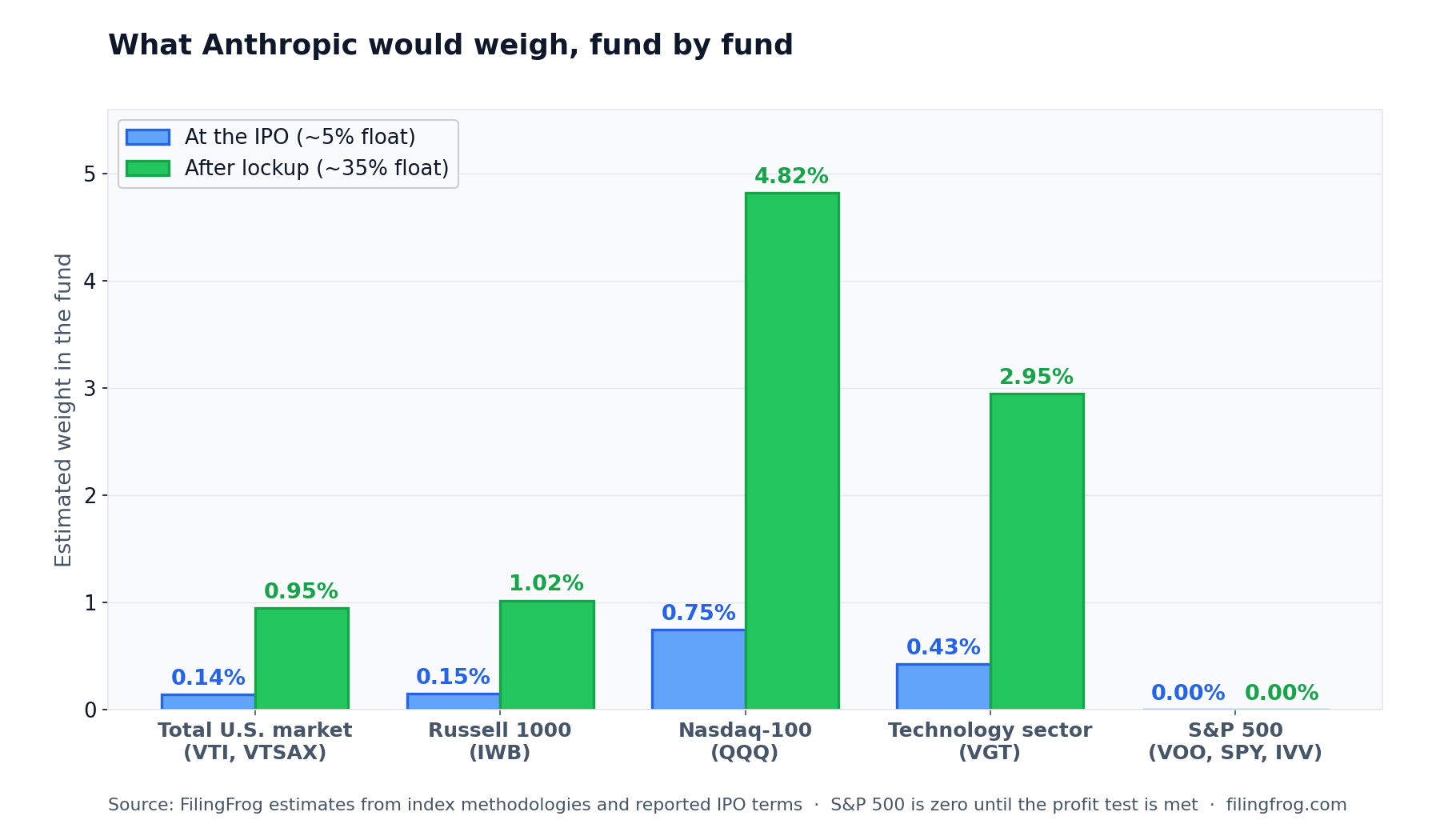
Once the lockups have run, the same fund would hold about 0.95% (roughly $95 per $10,000), and a technology sector fund close to 3%. Those are real positions, but they're a long way from the headline. The one place the math comes out higher is the Nasdaq-100, and for an unusual reason.
In the Nasdaq-100, the low-float penalty stops applying
Nasdaq counts a thinly floated stock at the lesser of its full value or three times its freely trading shares. At a 5% float that cap binds: three times $100 billion is $300 billion, so Anthropic would enter at about 0.75% of the index rather than the 4%-plus its full size implies. Once the float passes a third of the company, though, three times the float exceeds the whole company, and the cap stops doing anything at all.
At a 35% float, Anthropic would count at its full $2 trillion, around 4.8% of the Nasdaq-100, or roughly $482 of every $10,000 in a fund like QQQ. For comparison, Nvidia (NVDA) is about 14% of that index today and the top ten names are about 72% of it. The saver who holds a Nasdaq-100 fund rather than a total-market one ends up with roughly five times the exposure to the same company.
SpaceX's float more than quadrupled in four months, and its weight followed
SpaceX shows how fast that float widens. It listed with about 4.9% of its shares tradable and was at roughly 22.6% by early October, released in tranches tied to earnings windows and fixed day counts rather than one cliff. Its Nasdaq-100 weight tracked it: about 1% on entry in July, 1.28% through the summer, then 2.82% after September's rebalance, more than doubling in a single reset. Around 40% of the company becomes tradable when the 180-day lockup completes on December 8, and Elon Musk's own stake stays locked until June 2027.
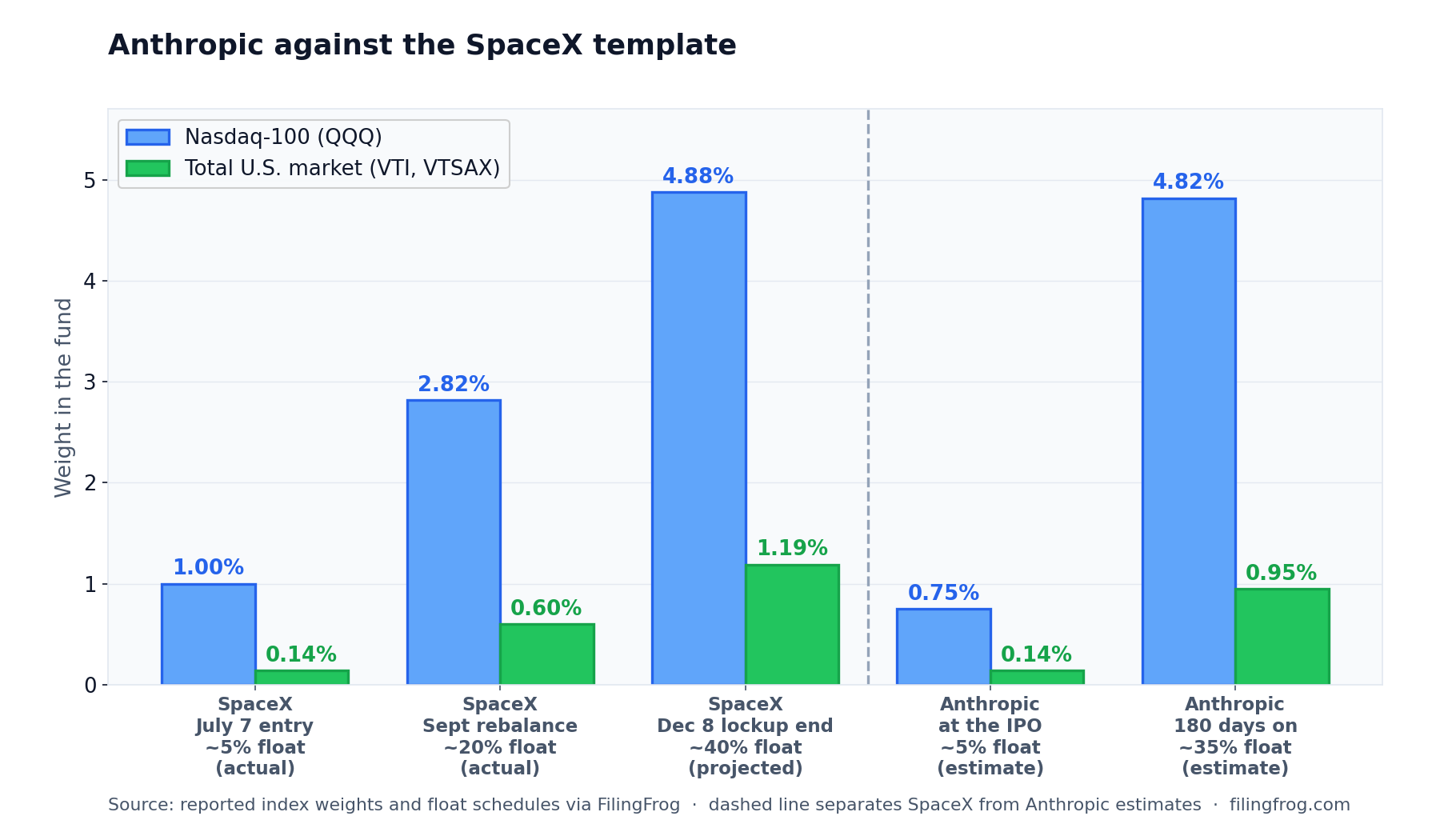
The two companies would enter at almost the same place: around 1% of the Nasdaq-100 and 0.14% of a total-market fund. The gap in headline size doesn't show up, because a similar sliver of each is floating. Later, the only thing separating them is how much of each one is permitted to trade. On the estimates here Anthropic ends up close to where SpaceX is heading in the Nasdaq-100, and roughly a fifth lighter in a total-market fund, where no three-times multiplier flatters a thin float.
The lesson from SpaceX is how fast this happens. The weight an index fund shows on listing day isn't the weight the same fund carries two quarters later, and the rebalance that moves it arrives without anyone deciding to buy.
An S&P 500 fund already holds more of it than any fund that can buy it
The S&P 500 is the building block at the center of most retirement menus, and on the day Anthropic lists its direct weight there is exactly zero. But Amazon and Alphabet are both large index constituents, and both are sitting on large Anthropic stakes. Amazon carried its position at $190.4 billion in June; Alphabet valued its private holdings, overwhelmingly Anthropic, at $124.3 billion at the end of the second quarter. At a $2 trillion listing those stakes are worth something closer to $350 billion and $280 billion.
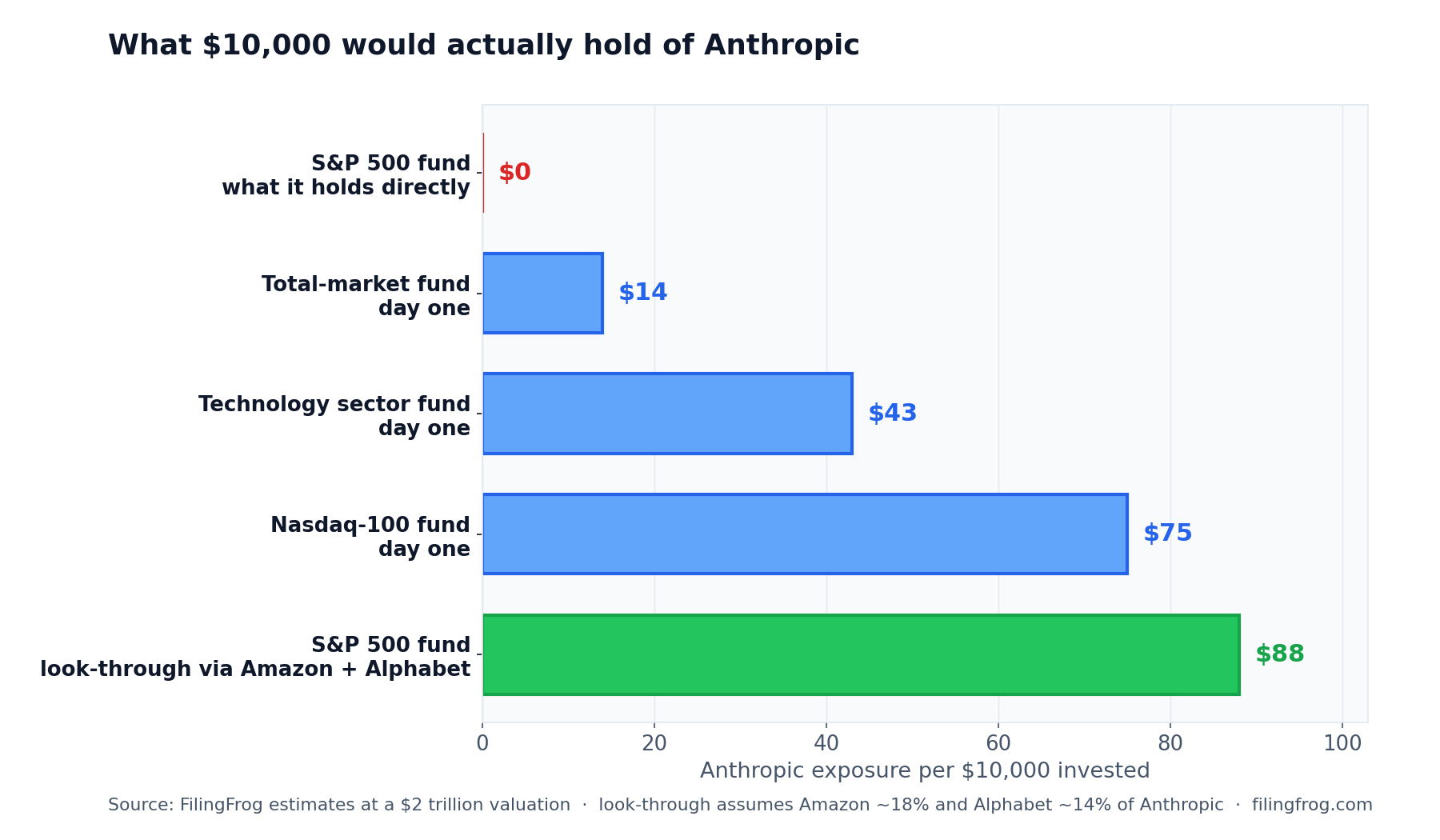
Work it through and an S&P 500 fund carries roughly 0.9% of its value in Anthropic, or about $88 per $10,000, with $49 of that arriving through Amazon and $39 through Alphabet. That's more than a total-market fund would hold on listing day, more than a Nasdaq-100 fund would, and close to what a total-market fund gets once the lockups have run. Savers holding the index that can't own it have had that exposure the whole time.
The fund filings have been marking this up for a year
Anthropic has been showing up in mutual fund and ETF disclosures for some time, and the trajectory is steep. At the end of June 2025, seven funds reported a position worth $33 million between them. A year later, 56 funds reported $7.49 billion. More than 100 funds have disclosed a position at some point in the last twelve months.
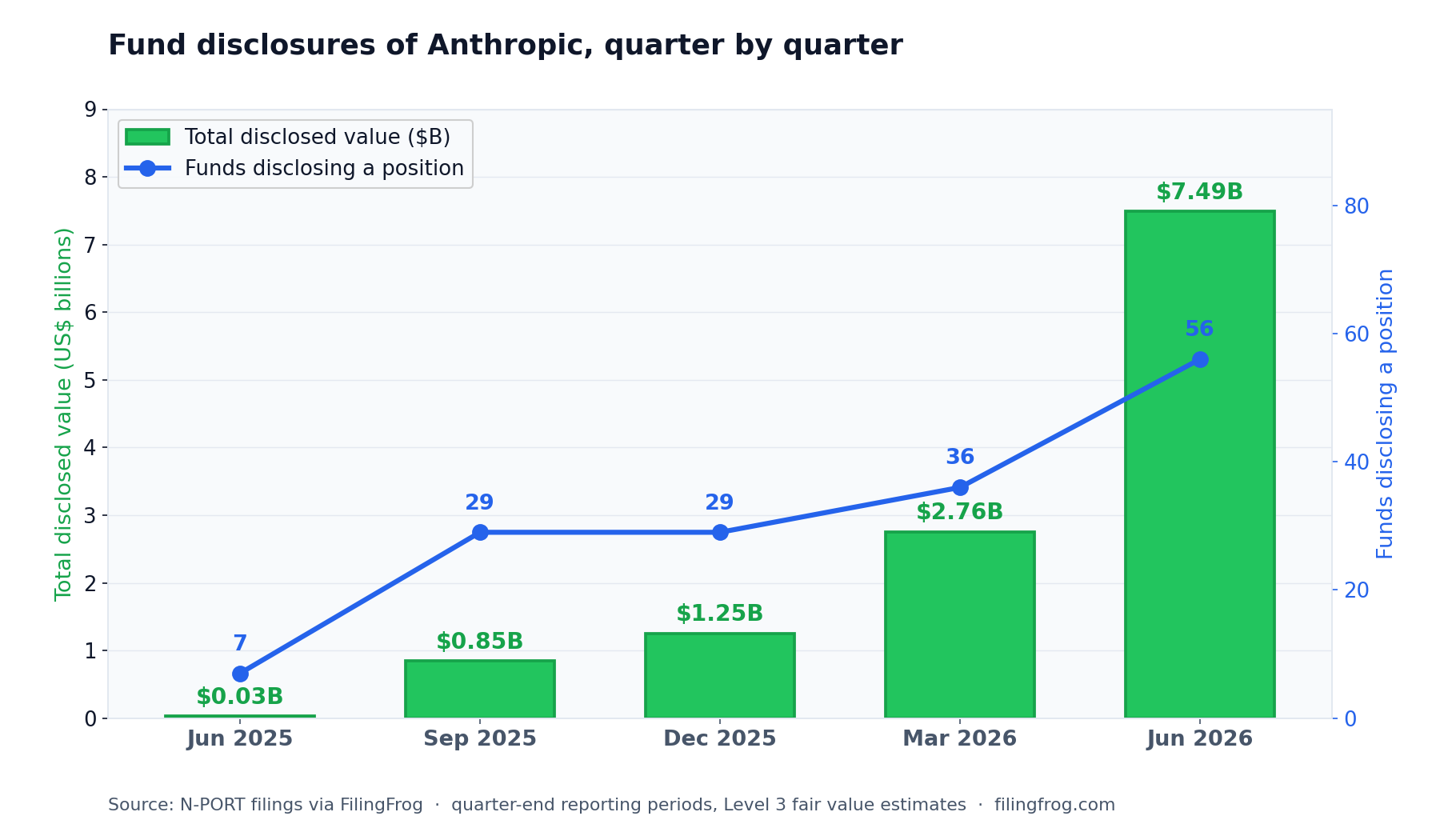
The marks are cleaner than the totals. Among funds that held the same number of shares across both periods, the most common change between the March and June reporting dates was +127%, and it was unanimous. Every matched fund moved by the same amount as they adopted the May round's reference price. The quarter before had been messier, with funds split across three different marks before most settled near +84%.
The heaviest positions by portfolio weight sit where you'd expect, in specialist and private-markets vehicles, but the biggest single position in dollars does not. That belongs to the Growth Fund of America, a $360 billion staple of workplace retirement menus, which reported $4.98 billion of Anthropic at 1.38% of the fund.
- Innovation Access Fund — 13.8% of the fund
- Coatue Innovative Strategies Fund — 11.5%
- BlackRock Technology & Private Equity Term Trust — 5.8%
- Alger Concentrated Equity ETF — 5.3%
- BlackRock Science & Technology Trust — 4.9%
- ARK Venture Fund — 4.2%
- Fidelity Select Technology Portfolio — 2.3%
On listing day, nothing visible happens to any of this. SpaceX appeared in 556 fund disclosures as a private position in June and two in August. The holdings didn't go anywhere. They became a listed stock and moved to the other side of the portfolio.
The valuation argument and the S&P test turn on the same number
Not everyone accepts $2 trillion as the price. The research firm New Constructs called it the most ridiculous IPO of 2026 and put fair value at $150 billion, noting the company would need profits about twice Nvidia's trailing four-quarter total to justify the headline.
The company's own numbers are less tidy than the run-rate suggests. Revenue was near $4.6 billion in 2025 against an $8.1 billion operating loss, and the net loss was around $42 billion once roughly $34 billion of accounting charges are counted. It also carries $518 billion of cloud and compute commitments over the next decade, about 80% of them non-cancelable. A $100 billion raise covers under a quarter of that.
The other side of it is the growth. Run-rate revenue went from about $9 billion at the end of 2025 to $14 billion in February, $30 billion in April and past $65 billion by July. Second-quarter revenue came in above $11.5 billion against $787 million a year earlier, with a first operating profit near $559 million. At $2 trillion that's roughly 31 times the current run rate and about 10 times what the company is forecast to earn in revenue in 2028.
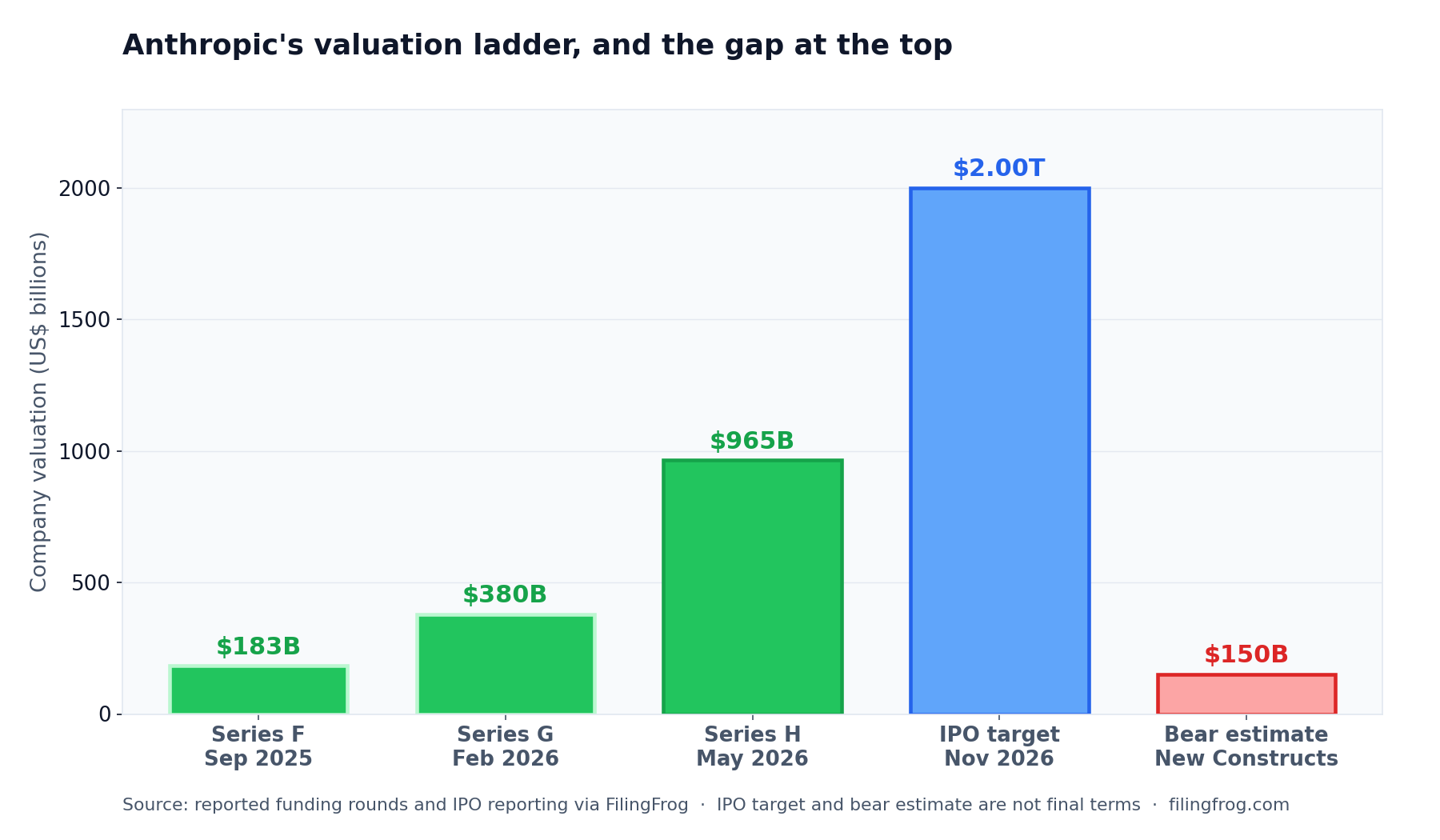
Whichever view is right also decides the index question. The S&P 500 test is positive GAAP earnings in the most recent quarter and across the trailing year, with no waiver for size. If the second-quarter operating profit is the start of something durable, Anthropic becomes the one member of this IPO class with a real path into the index, in late 2027 at the earliest. If it isn't, the weight stays at zero and the only Anthropic in an S&P 500 fund remains the Anthropic inside Amazon and Alphabet.
Amazon and Alphabet are Anthropic's two largest customers as well as its two largest shareholders, together accounting for roughly a quarter of 2025 revenue at about 12% each. The look-through exposure in an S&P 500 fund and the customer concentration reported from Anthropic's IPO filing are, in part, the same relationship counted twice.
Explore Fund HoldingsNotes
Fund position data is drawn from N-PORT filings covering June 2025 through July 2026, as reported to FilingFrog. Anthropic position values are fund-reported Level 3 fair value estimates, not market prices, and the mark changes quoted compare only fund-series whose share counts were unchanged across both reporting dates. Portfolio weights are each fund's most recent reported period; because N-PORT reporting is staggered, those periods are not all the same month. The SpaceX disclosure counts (556 in June, two in August) reflect the private-securities tag only. After listing, the same holdings appear as ordinary equity positions.
IPO figures are reported terms, not filed ones. Anthropic submitted a confidential draft registration statement on June 1, 2026, and no public prospectus had appeared on EDGAR as of early October. The ~$2 trillion valuation, the up-to-$100 billion raise, the Nasdaq venue, the November timing and the underwriting syndicate are all press reporting and remain unconfirmed; the share count, price range and float have not been set. Valuation history reflects the September 2025 Series F at $183 billion, the February 2026 Series G at $380 billion post-money and the May 28, 2026 Series H at $965 billion post-money.
Index weights and the per-$10,000 figures are estimates. They divide Anthropic's float-adjusted value by the relevant index total (CRSP US total market ≈ $73 trillion; Russell 1000 ≈ $68 trillion; Nasdaq-100 ≈ $39.5 trillion; technology sector ≈ $23 trillion) and assume a 5% float at listing and 35% once the lockups have run, since index funds count only the shares that trade. SpaceX's own figures are a mix: the July entry weight and the 2.82% post-rebalance Nasdaq-100 weight are reported, the 0.14% total-market weight is its June 30 holding in VTI, and the December 8 figures scale its reported ~40% tradable share against current index totals. Its free-float schedule (4.9% at listing, ~22.6% in early October, ~40% by December 8, with Elon Musk's stake locked to June 2027) is from reported unlock timetables; shares becoming tradable and shares counting as index float are not always the same thing, since providers exclude large strategic and insider blocks regardless of lockup status. The Nasdaq-100 additionally caps a low-float stock at three times its free float, which binds at the IPO and stops binding above a one-third float. Float percentages are estimates, not disclosures, and the resulting weights move with price and with how much locked stock is actually sold.
The S&P 500 look-through figure assumes Amazon holds about 18% of Anthropic and Alphabet about 14% (reported ranges are 15–20% and roughly 14% capped at 15%), valued at a $2 trillion Anthropic, against Amazon's ~$2.8 trillion market value at a 3.79% index weight and Alphabet's ~$4.2 trillion across both share classes at a combined 5.87%. It is gross look-through exposure before tax and before any dilution from the offering itself, and it halves if Anthropic prices nearer its last private mark. Amazon's position is held largely as non-voting preferred stock and convertible notes rather than common equity.
Cross-fund views of the private position are at Anthropic, OpenAI and SpaceX; fund-level holdings and history are in the fund section. An earlier piece worked the same question for all three companies before SpaceX listed: SpaceX, OpenAI, and Anthropic Are Going Public.